


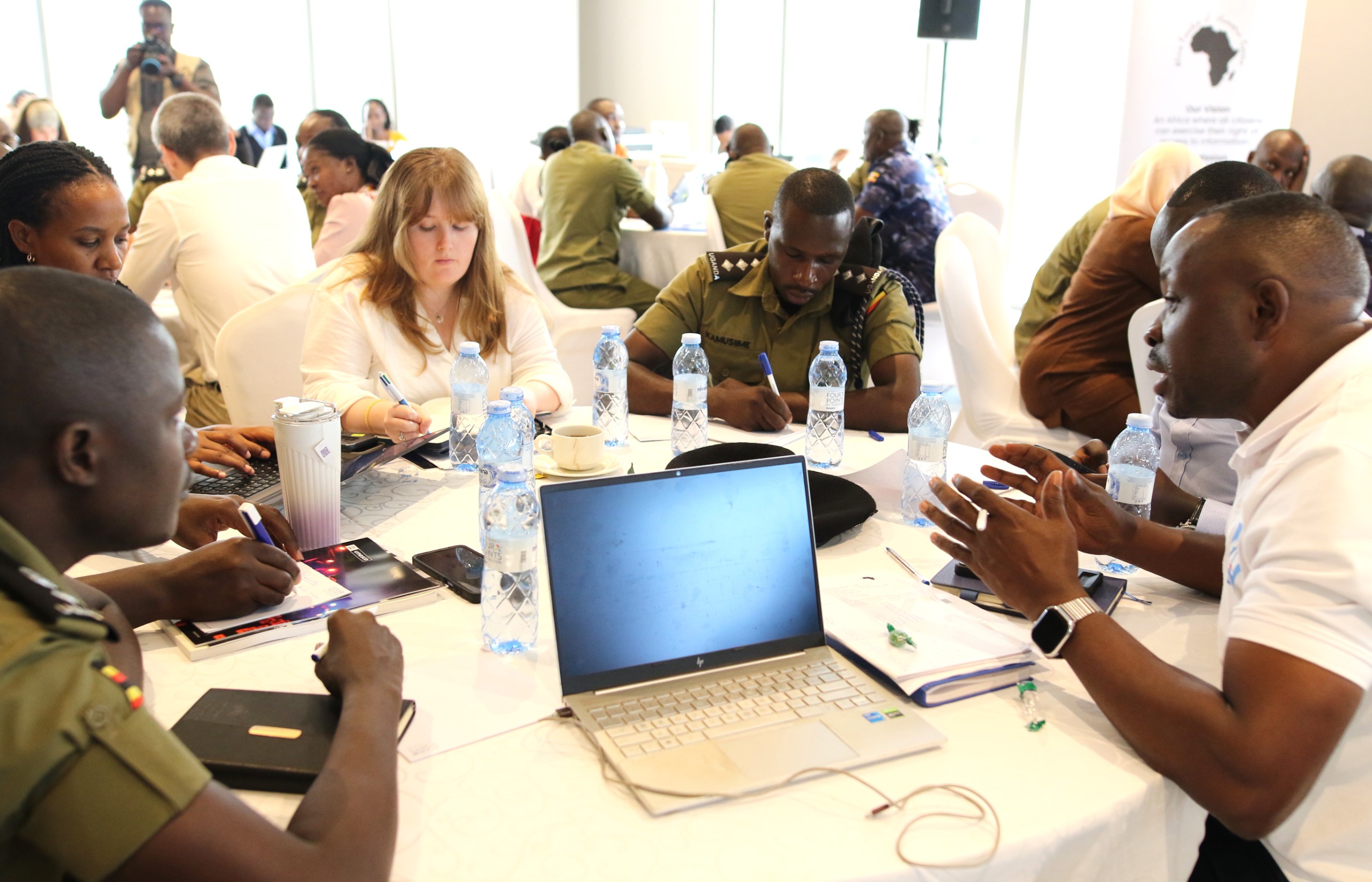
It started with tension in the room. On one side of the room, uniformed police officers. On the other, journalists—some of whom had once been manhandled by those very uniforms.
But something remarkable happened over two days in April 2025.
In a workshop convened by the Africa Freedom of Information Centre (AFIC) with support from UNESCO, journalists and security personnel came together in Kampala—not for conflict, but for conversation.
And what began as guarded silence turned into something powerful: understanding.
A history of mistrust
For years, media and security forces in Uganda have had a complicated relationship. Journalists covering protests or political events often find themselves facing threats, confiscated equipment—or worse. On the other hand, police officers feel that their work is misrepresented and misunderstood by the media.
“We often feel like journalists are out to expose us, not to report objectively,” one officer said during the workshop.
From the media side, the stories were just as raw. One participant shared how they were assaulted while covering a political rally. “We do our jobs with fear,” they said. “Yet we’re also just trying to serve the public.”
That’s why this workshop was different.
Changing the narrative
Over two days, something began to shift.
Through interactive sessions on freedom of expression, journalist safety, and public order, participants began to see each other not just as roles but as people.
“No one is an enemy of the other,” said one officer. “We’re all doing our jobs.”
Another participant, a journalist, reflected, “This was the first time I sat across from a police commander and really listened. And they listened back. That’s new.”
They discussed real challenges: police working without clear protocols on how to handle media during tense events. Journalists lacking safety gear. Female reporters face gender-specific threats. The rise of impostors posing as journalists and complicating field operations.
But more importantly, they started co-creating solutions.
What they agreed on
By the end of the workshop, there was consensus on one thing: this can’t be a one-off.
Here’s what they proposed:
✅ Establishing a journalist verification system to prevent impersonation.
✅ Regular pre-election safety briefings between editors and police commanders.
✅ Freedom of expression modules integrated into police academy training.
✅ Joint development of a media-police Standard Operating Procedure (SOP) manual.
✅ Expanding these trainings to regions like Gulu, Arua, Fort Portal, and Karamoja.
And the boldest move yet? Engaging the Uganda People’s Defence Forces (UPDF) to bring them into the conversation.
Looking ahead to 2026
Uganda heads to the polls in 2026. The stakes are high—not just for political parties, but for the health of our democracy.
As one participant put it, “We can’t afford another election season where journalists are battered and officers feel ambushed. We need systems. We need respect.”
AFIC is now developing a national rollout plan, guided by the feedback and ideas born in that room. With support from UNESCO, the goal is clear: to build a culture of mutual respect and institutionalized protection for the right to information and expression.
Because democracy doesn’t just happen at the ballot box. It starts with a free, safe press—and a public order system that understands and upholds that freedom.
“We need each other.”
That’s how one participant summed it up.
Not every problem was solved in those two days. But something shifted. Dialogue began. And in that space, new possibilities emerged.
At AFIC, we’re committed to keeping that door open. Ahead of 2026 and beyond.
Want to learn more or get involved in upcoming regional dialogues? Follow our X handle; (@africafoicentre) / X
