


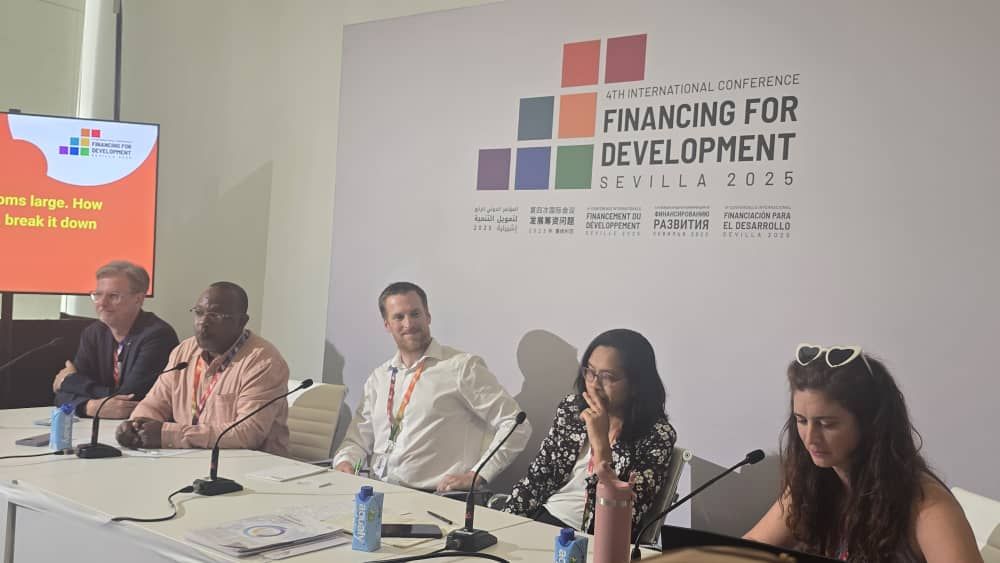
As global leaders, development agencies, and civil society actors gathered in Seville for the 4th International Conference on Financing for Development (FFD4), a recurring theme echoed across sessions: the need to rethink how climate finance is delivered, tracked, and evaluated.
At the Africa Freedom of Information Centre (AFIC), we believe this moment represents a turning point. It is no longer enough to announce billions in commitments. What matters now is who benefits, what impact is achieved, and whether communities most affected by climate change are meaningfully involved.
Over the last decade, climate finance has become a central pillar of global development. Yet across Africa, the mismatch between reported investments and actual outcomes on the ground remains striking. While donors and governments speak of increasing resources and results, communities facing the harshest impacts of climate change rural farmers, women, youth, and displaced populations still grapple with poor infrastructure, lack of access to services, and minimal participation in the decisions that affect them.
At AFIC, we see this disconnect clearly through our research, our fieldwork, and our network of community monitors across the continent. Too often:
Project data is incomplete or inaccessible.
No clear trackers exist to follow the money from commitment to implementation.
Stakeholders are excluded from conversations on how funds are allocated.
Accountability mechanisms are weak or nonexistent.
This is not just a failure of policy. It’s a systemic failure of transparency, access to information, and civic engagement.
“There is a big mismatch between what is reported by donors and governments, and the reality communities experience on the ground,” said Gilbert Sendugwa, AFIC’s Executive Director, speaking on a high-level FFD4 panel on tracking climate finance for results.
As we advocated in Seville, citizen monitoring and civil society oversight are not optional. They are foundational to making climate finance work. When citizens can access information, ask questions, and track investments, outcomes improve. Resources are better targeted. Waste and corruption are reduced. Trust is built.
However, we are operating in an increasingly hostile environment. Across many African countries, civic space is shrinking, while new grant restrictions from international partners, including the recent closure of USAID operations in Uganda, are further undermining transparency, capacity building, and civil society innovation.
This trend is deeply worrying.
AFIC knows the value of long-term investment in local institutions. Our work tracking procurement data, auditing public infrastructure, and investigating donor-funded climate projects has been shaped by decades of partnerships with donors like USAID. We are not only recipients of grants. We are evidence of how investment in systems, skills, and leadership yields lasting change.
Building a future-ready climate finance ecosystem
Looking ahead, AFIC is advancing new approaches to climate finance accountability:
Scaling up our grassroots citizen monitoring networks to track climate and infrastructure projects in real time.
Pushing for mandatory disclosure of climate finance flows, including at the subnational level.
Producing evidence on the intersection of climate change, gender, and conflict to ensure that climate finance is inclusive and responsive.
Advocating for regional and continental action, including from the African Union, to ensure African voices shape the climate finance agenda.
We envision a climate finance ecosystem where:
Communities can follow the money from pledge to project.
Data is open, comparable, and timely.
Women and marginalized groups have a seat at the table.
Impact is measured not just in dollars, but in dignity.
The FFD4 was an important moment. But real change won’t happen in conference halls; it will happen in rural clinics, flood-prone villages, and across our growing network of grassroots monitors who hold the system accountable.
The way forward
AFIC is calling on governments, donors, multilateral agencies, and the private sector to make three urgent shifts:
Mandate transparency in all climate finance commitments, disbursements, and results.
Invest in civic technology and citizen-led monitoring to track delivery and outcomes.
Protect civic space and local leadership as essential to achieving climate justice.
The future of climate finance must be participatory, transparent, and equitable.
Africa Freedom of Information Centre (AFIC) is a pan-African civil society organization promoting access to information, transparency, accountability, and citizen engagement across Africa. Learn more about what we are doing around climate finance work by reading our strategic plan.
