


Water is a basic prerequisite for schools to function properly. It is impossible to maintain basic hygiene standards in the absence of water, which can lead to the development of diseases such as diarrhea, cholera, and typhoid.
Furthermore, a lack of access to water can lead to absenteeism, especially among young girls who may have to go considerable distances to gather water for their families rather than attending school.
According to UNICEF, roughly 50% of schools in Sub-Saharan Africa lack access to water and sanitation facilities, resulting in poor student hygiene and health results.
The Government of Uganda is committed to the realization of good health and well-being for all (SDG 3),
quality education for boys and girls (SDG 4) and access to clean water and sanitation (SDG 6).
Accordingly, through national budget and donor support, the government has invested heavily in pursuit of these
noble objectives.
How service delivery is affected by lack of information
However, through a grant from the William Flora and Hewlett Foundation, African Freedom of Information Centre (AFIC) has learnt that good intentions and investments can be affected by lack of informed beneficiary participation and feedback.
To address the issue of water scarcity in schools, the Ugandan government has included a rainwater harvesting tank as part of the design for the construction and upgrading of primary schools in several districts across the country.
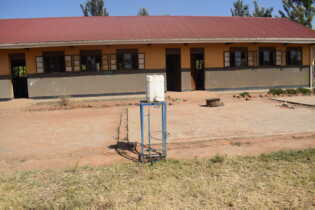
Under the 2020/2021 Financial year, Mbale District Local Government issued a contract to Tsandex Investments (U) Ltd for the construction of a 3-classroom block at Khamoto Primary School with a ten thousand (10,000) litre water harvesting tank, plastic gutters, heavy duty Polyvinyl Chloride (PVC) rainwater pipes as well as black and pin boards in each of the classrooms.
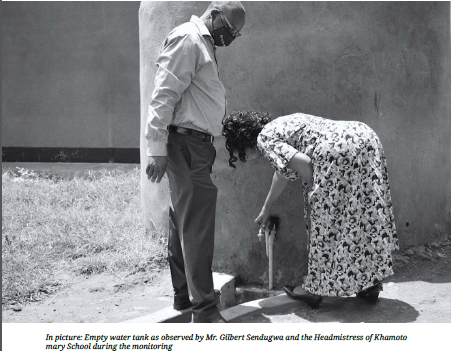
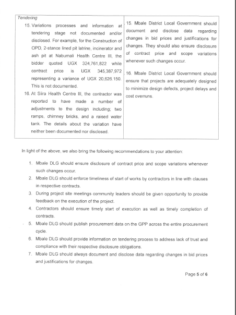
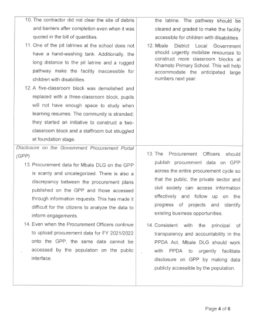
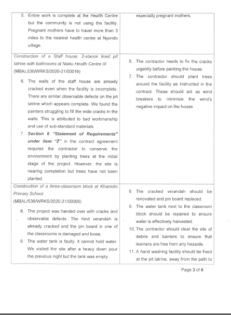
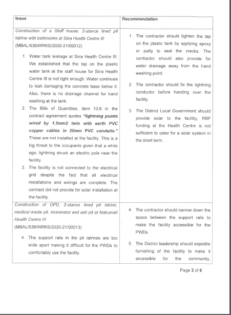
The contracts monitoring exercise conducted by AFIC, on October 4, 2021 identified that the project was in its hand over processes although, with notable challenges. Despite the heavy rain downpour the previous night, the water harvesting tank was empty.
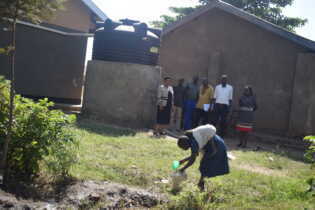
This means that the facility could not serve its purpose of increasing access to water following completion.
The Head Teacher, Ms. Sarah Nambozo and the chairperson School Management Committee, Mr. Eriab
Nkaaga confirmed that the tank had not been used in spite of the project having been declared complete
and handed over by the contractor to the district three months before the final monitoring by AFIC.
This means that the facility could not serve its purpose of increasing access to water following completion.
Findings from the AFIC monitoring exercise
On close examination of the completed installation, it was discovered that the gutters were wrongly installed,
thus the water was flowing in the opposite direction. In addition, one of the pin boards was torn and poorly fixed.
Furthermore, the monitoring revealed that neither the head teacher nor other community members had been given a copy of the contract nor detailed information on the project to enable them meaningfully engage.
Following these discoveries, AFIC compiled and submitted a report with findings and recommendations to
Mbale District Local Government. This called on the contractor to be compelled to return to the site and fix the
defects and issues established by the monitoring.
Following receipt of AFIC recommendations, Mbale district authorities sent an officer to verify the concerns.
Upon confirmation, the problems identified were in tandem with concerns raised in the AFIC report, and the district committed to fix them. A few days later, the contractor returned to the site and fixed the gutter.
During an AFIC follow-up monitoring visit to the school, on December 1, 2021 AFIC confirmed that the gutter was fixed and the water tank was well positioned for water harvesting.
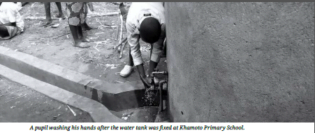
Although the school was yet to open due to the Covid-19 lockdown, the water tank was already benefiting over six families of more than seventy people including women and children who live nearby the school.
As schools opened in January 2022, over one thousand pupils were using the water from this tank. This is
very important for their hygiene but also Covid-19 prevention campaign which emphasizes regular hand
washing with soap.
Testimonies from users of the facility illustrate how the water harvesting tank has relieved them of the
longstanding challenge of lack of access to clean and safe water.
Ms. Caroline Khaitsa, a mother and bread winner of ten family members (5 boys and 5 girls)reveals that they used to walk 3 kilometers to the nearest borehole to fetch water for drinking, washing and cooking.
They would experience long lines given that the borehole serves over five hundred people in the whole of Nambale village. This would affect her ability to get enough time to look after the family. As well, affected children’s ability to attend school regularly.
She adds that during the hot season the situation was worse.
“We used to walk 3 kilometres to the nearest borehole in search of water. Our borehole serves over 500
people in Nambale Village. Most often my children would meander around looking for water in vain. The
situation gets worse during the dry season when many people are forced to go to the only borehole,
which sometimes dries up. This would affect the time for preparation of meals, taking care of my children.
With the water harvesting tank at the school, I get water with ease and my home keeps clean, I am
grateful to the district for this project.” Ms. Khaitsa explains her experience
Its not only Khaitsa who has benefited from this, other community members like Mr. Tom Musalala, also a beneficiary of this water, shares the same experience as Caroline.
