


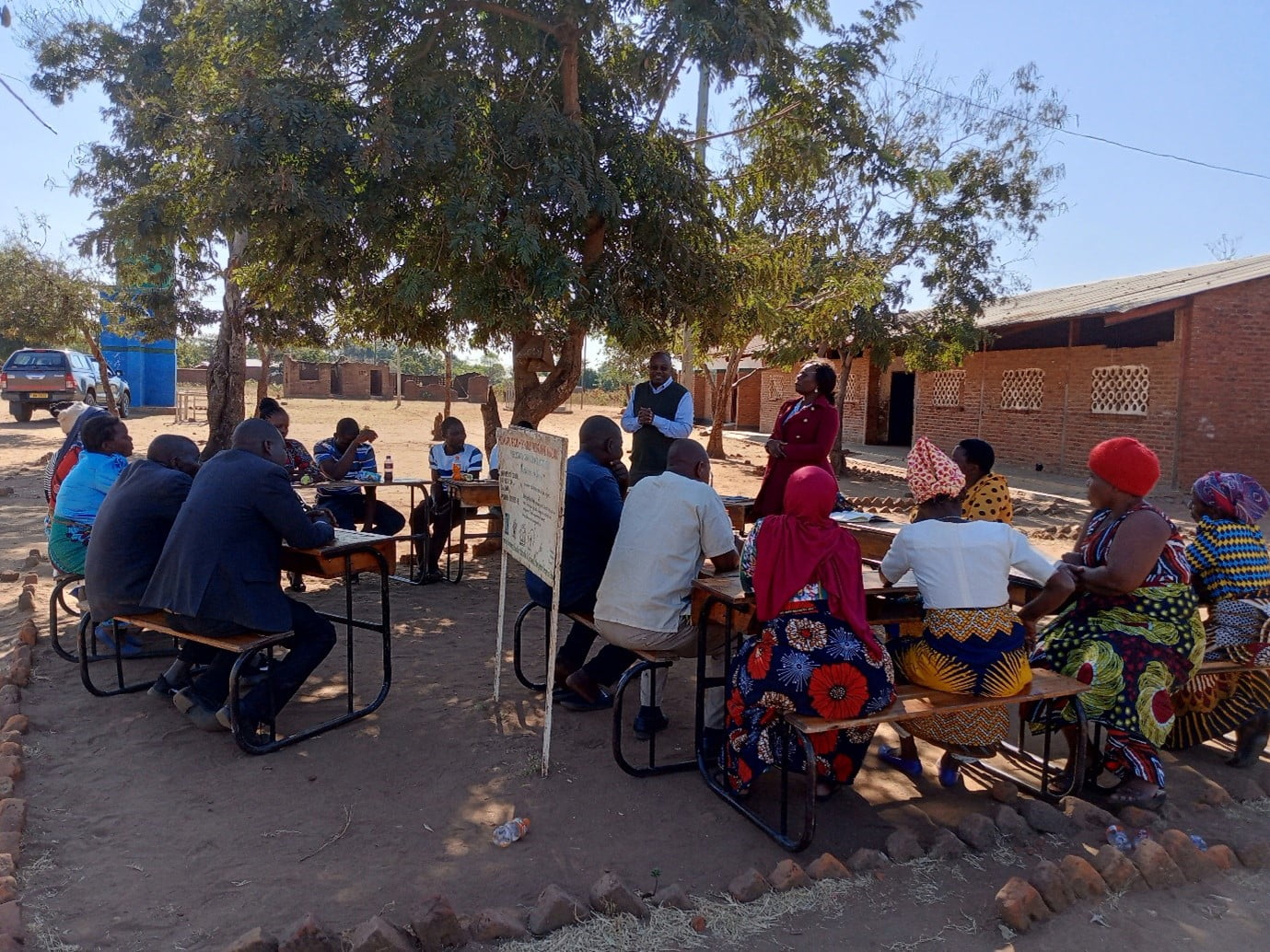
With support from Hewlette foundation, Africa Freedom of Information Centre has worked to improve delivery of health and education services through promotion of disclosure, public participation, efficiency, value for money and competition in public contracting in Malawi, Kenya, Ghana, Nigeria and Uganda. Tremendous impact has been made across the project countries.
Stories of Change from Malawi
Citizen led activism: Trained community monitor influences completion of a stalled classroom block at Lithipe primary school, Salima, Malawi
Introduction
Linthipe Primary School, located in the GVH Gwirize Traditional Authority Pemba in Salima, is a full public primary school covering standards one through eight. It is a home to over seven (7) thousand students. The school serves a large population of students from surrounding communities in three (3) group villages namely: Gwirize, Chindugwa, Ntenda. The school has only three double classroom blocks and one newly constructed single block classroom. This is quite insignificant comparing to the student population. There are also more students in each classroom in comparison with the teacher ratio due to lack of adequate teaching personnel.
Issue/Problem
The COVID-19 pandemic has had a major impact on schools across Malawi, from school closures to remote learning. In Malawi, schools closed for five months in March 2020 as a precaution against the pandemic until September 2020, with fears on how to keep students and teachers safe in schools. The government of Malawi, just as many governments around the world, put in place measures to help prevent the prevalence of Covid-19 virus while continuing education in schools. This included financing different initiatives at school and community levels as a response package. From these initiatives, Linthe Primary School was awarded Four million Malawi Kwacha through Salima District Council to construct an additional classroom block to help reduce student congestion in classrooms, allow for social distancing, and prevent Covid-19 at the school. The award of funds for additional classroom blocks was exciting news and welcomed development to the community considering their already existing challenges with a large student population and limited classrooms.
However, things did not go according to plan. The contractor who was recommended by an official and not through formal procurement at Salima District Council to construct the additional classroom block from the Covid-19 Response Funds did not live up to his commitment. After collecting about 37.5% as upfront payment for the construction project, the contractor abandoned the works, and instead used the money for other personal things. Intervention Edrina Kenamu, a resident of traditional authority Pemba and one of the community monitors who were trained by CHRR on access to information and contract monitoring upon learning about this sad development in her community, did not just fold her arms or hesitate, but instead got to work. Although this particular school was not initially among the targeted institutions for monitoring under the Hewlett fund, the monitor used her skills to influence effective delivery of the project.
Result
Edrina mobilized other community members to follow up on the construction project. The community collectively approached and engaged Salima District Council who were the custodians of the Covid-19 response funds requesting for information which led to the arrest of the contractor and subsequent refund of all the money that was used by the contractor. Following these developments, the community agreed to allow local artisans to complete the project. This was another benefit for the community for taking action. Physical inspection of the project around November 2021 revealed that construction works stood at about 95% to completion.
Construction of additional classroom block with Covid-19 response Funds at Linthipe Primary School almost complete. With these improvements, the school community is appreciative of the monitor’s activism and determined to support their work, noting that, “there is no good action that is small to have an impact” This action has also motivated the traditional leaders (chiefs), School Management Committee (SMC), and community members to commit to using the experience gained from this exercise to follow up on other development projects at the school such as construction of teachers houses which has been stalled for over two years. These projects stalled waiting for CDF funding as was promised by the Member of Parliament for the area but the community believes that some funds were misappropriated, and the leaders were following up this matter.
Conclusion
The experiences, results and lessons included in this report are an example of the results of the intervention undertaken by AFIC and its partners with financial support from the Hewlett foundation. These experiences speak to the value of access to information as the bridge to citizen empowerment, service delivery monitoring and influencing sector reforms. We have noted across the partners how access to information has facilitated access to contract sites, partnerships with government bodies and influenced decisions. In Uganda and Kenya for example, access to information enabled registration of new entities on the procurement portal and revival of a procurement portal designed two years later respectively. While in Malawi and Uganda we see how training of citizens as monitors has influenced completion of stalled projects attracting action by key public officials such as a Minister in Uganda. These examples continue to present to us the fact that disclosure alone can result in less without the human aspect such as monitors and the media to use the data to influence reforms.
Our lessons
Throughout project implementation across the five countries, we have learnt several lessons which include the following:
1. Informed Citizens, Informed Demand and Participation When citizens are trained and equipped with knowledge on how to access and use government information, they actively demand for this information and use it to track the delivery of government contracts and services from an informed point of view. We note from the project that across the countries, there was increase in filing of information requests and use of proactively disclosed data by trained CSOs and community monitors. Requested information included contracts, bills of quantities, payment information and reports on projects. Using accessed information, community monitors and CSOs were able to track and engage authorities on specific issues rather than generalised and untargeted comments. This in turn assisted authorities to address specific issues that community members raised.
2. Lack of awareness and capacity of public officials a critical factor for responsiveness Across project countries, officials were not complying with their disclosure obligations in spite of existing laws and government policies. The original assumption of our project teams was that there was absence of political will to disclose public information. However, following training by the project on disclosure obligations, why, how and where to disclose, significant improvement in their proactively disclosing information as well as responding to information requests. This is despite the fact that information requests by citizen groups had increased following their training. In a number of countries, public officials indicated that having learnt from the project that disclosure improves public trust this became a key incentive.
3. Evidence and how it is presented matters for Public Officials In Malawi, Uganda and across all the project countries the project learnt that civil servants and public officials act on compelling information that is presented to them in a constructive manner. Citizen monitoring revealed major issues which upon being brough to the attention of authorities were verified and contractors compelled to fix them. In a number of cases officials appreciated community monitors for bringing issues directly their attention rather than simply publishing them on social media and other platforms without providing context. For example, when community monitors provided feedback about the abandoned construction of Linthipe Primary School, located in the GVH Gwirize Traditional Authority Pemba in Salima in Malawi, the public officials took up the matter and were able to act. Drawing from this lesson, the project has strengthened its efforts and resources to engage authorities on key findings and recommendations to help them appreciate and address issues of concern.
4. Competition is a strong incentive for transparency Across the five project countries, transparency is a principle that is embedded in all their respective procurement laws, indeed in Uganda and Nigeria, governments have established portals on which data on planning, tender, evaluation, award and contract execution should be published. These portals are aligned to the Open Contracting data Standard which allows for better access and use of disclosed data. In practice however, most agencies were not disclosing as required and expected. The project implemented freedom of information rankings by assessing levels of disclosure of each agency, published findings at a public event where assessed institutions were present alongside media organisations which provided strong coverage of the results. This ranking and media coverage generated strong debate and government agencies responded by promising to beat each other in being the best next time. In practice, the project has observed very positive trend in disclosing procurement information. This lesson is critical for other countries as well where a similar situation pertains.
5. Improved disclosure and citizen engagement leads to better service delivery. We have learnt that a combination of government disclosure of information, use of that information by citizens to track service delivery, providing feedback to responsible government actors and timely action on the feedback by government results in better service delivery to citizens. Across the project countries, it was found that when government projects face one challenge or another when communities know nothing about them. We also observed that when disclosure takes place, but citizens have the capacity to track projects, still issues remain. For example, in Uganda when monitors accessed a contract for the construction of a classroom block in Khamoto primary school, they monitored and found a defect with the water gutter provided feedback, the government corrected the defects, and the tank was able to harvest water which serves the school community and the teachers.
Read more stories of change from Malawi: https://www.africafoicentre.org/how-contracts-monitoring-impacts-service-delivery/
Stories of change from other countries: https://www.africafoicentre.org/wpdmpro/voice-of-change-impact-stories/
Get In Touch With Us Today
- Civil Society Letter to States Parties to United Nations Convention against Corruption
- Promoting Freedom of Expression and Access to Information in East Africa: AFIC Launches New UNESCO–IPDC Project
- Reclaiming Our Data Futures: AFIC Leads Community Dialogue on ACHPR Resolution 620 at DataFest Africa 2025
- Uganda Marks IDUAI 2025 with a Call for Digital Accessibility to Public Information
- Sénégal : La promulgation de la loi sur l’accèsà l’information, une étape importante pour la transparence
