


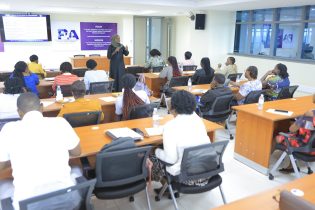
Public Procurement and Disposal of Public Assets Authority (PPDA) in collaboration with the Africa Freedom of Information Centre (AFIC) with support from Open Contracting Partnership (OCP) conducted a baseline study that delved into participation of Women Owned Businesses (WOBs) in public procurement. This was done among four pilot entities that is two Procurement and Disposing Entities (PDEs) of Mbarara City and Wakiso District Local Government and two central government entities of Kampala Capital City Authority (KCCA) and Uganda Electricity Generation Company Limited (UEGCL).
According to the baseline study, WOBs represent a significant portion of the entrepreneurial landscape contributing to economic growth and livelihood improvement. It was noted that there’s still limited participation of these businesses in public procurement bids. This is due to limited access to information, financial constraints and lack of disaggregated data to monitor their participation.
The purpose of the baseline study was aimed at making findings and making recommendations to inspire meaningful action among stakeholders to create an enabling environment for WoBs, in addressing the different barriers, foster an inclusive procurement system, adopting gender-responsive policies and empowering women entrepreneurs with tools and information needed to compete effectively.
In April and May 2024, AFIC and PPDA conducted capacity building workshops for Women Led Businesses (WLBs) with three of these in Kampala, and one in Mbarara City that were aimed at promoting participation of women in public procurement.
The baseline study adopted different methodologies to find accurate data and a pilot approach was adopted that focused on KCCA, UEGCL, Mbarara City and Wakiso District Local Government. The team further focused on “high spend entities” as a way of assessing the impact on substantial expenditure areas.
A rigorous data collection, data cleaning and data analysis exercise was done to establish, among other things, the proportion of public contracts awarded to WoBs (Number) and the proportion of public contracts awarded to WoBs (value) plus participation rates and the distribution of contract types.
FINDINGS
The assessment reviewed 2,635 contracts with a combined value of over 98 billion UGX. It was revealed that Male Owned Businesses (MOBs) dominate the number of contracts across all entities particularly KCCA and UEGCL. In Mbarara and Wakiso, the figure stands at 18% and 6% respectively.
It was also established that KCCA, among the pilot entities, is leading in terms of awarding contracts to WoBs at 18% followed by UEGCL (11%), with Mbarara City and Wakiso awarding 6% of contracts to WOBs. Majority of these were non-consultancy contracts.
LIMITATIONS
The study encountered numerous challenges that included missing values, data accuracy, company information variability, incomplete company documentation and coverage and these are attributed by poor record keeping, limited use of technology when applying for bids.
BARRIERS HINDERING WOBs FROM PARTICIPATING IN BIDDING FOR GOVERNMENT CONTRACTS
It was discovered that the low number of WoBs participating in public procurement bids is due to the following barriers namely;
- Lack of knowledge about the bidding process.
- Inability to win bids and discouragement.
- Lack of information.
- Perceived gender bias.
- Complexity and high costs.
- Corruption and lack of trust
RECOMMENDATIONS TO IMPROVE PARTICIPATION OF WOBs
In order to ensure that Public Procurement serves as a tool for advancing gender equality and economic empowerment in Uganda, the study observes that there’s need:
- Increase capacity building and training programs.
- For ringfencing and enforcement of guidelines to promote Special Interest Groups (SIGs).
- Establishment of a compliance monitoring team to assess progress and challenges in the implementation of these guidelines.
- For regular monitoring and evaluation mechanisms.
- For accessibility and ease of participation of these SIGs.
- For timely payments and accountability for services provided.
- For combating corruption at all levels.
The LIFT program has made significant strides in terms of bridging the public procurement information gap, however, there’s still a lot that needs to be done in order to encourage more participation of WOBs in the public procurement process.
Please find the full Baseline Report here.
Skip to PDF content