


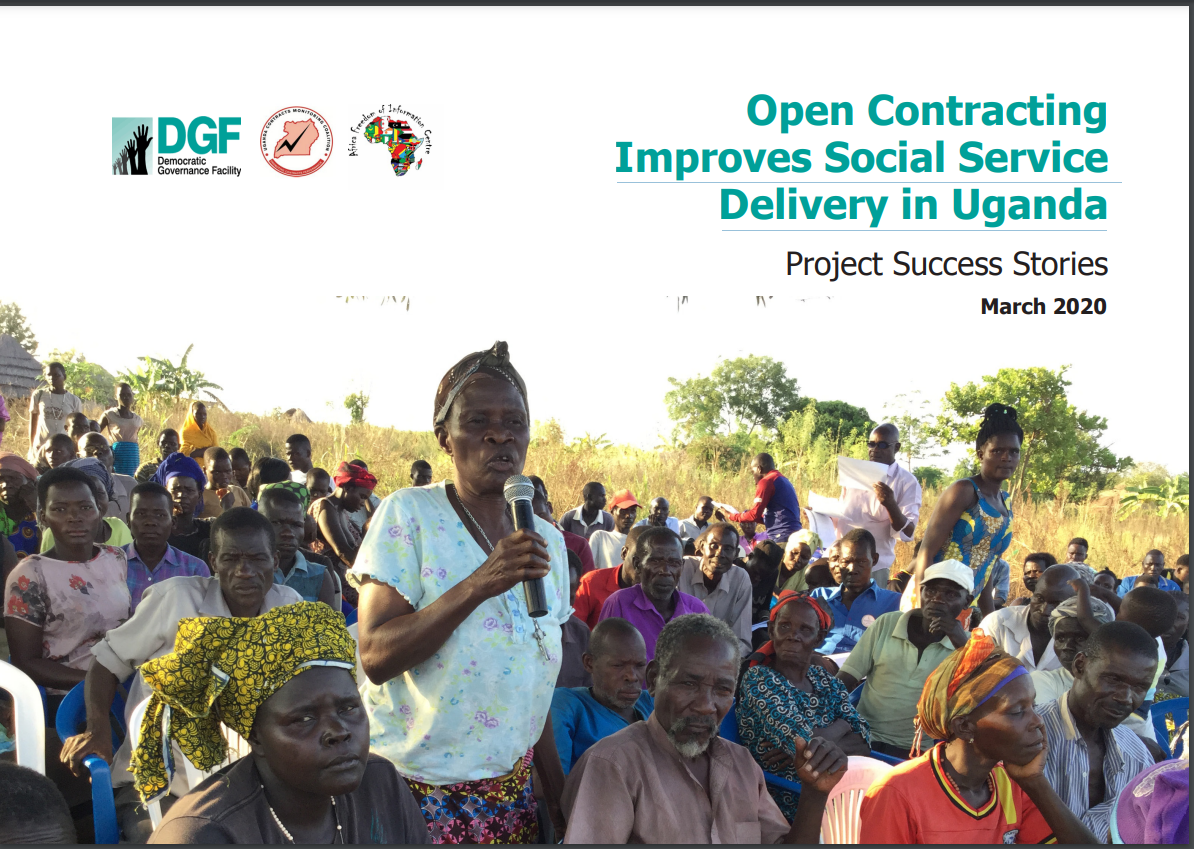
Open Contracting Improves Social Service Delivery in Uganda
Introduction
Globally, governments spend approximately USD 9.5 trillion annually in public contracting . However, the rate of return on this investment is quite low because public procurement is faced with a myriad of challenges including ranging from collusion, fraud, diversion of funds, lack of public participation, absence of competition and lack of adequate oversight among others. The Economic Co-operation and Development (OECD) estimates that every year 20% -30% of the value of the public contracts is lost through corruption alone2 . In Uganda, public expenditure has expanded several folds from UGX 7 trillion in Financial Year (FY) 2010/20113 to 26.360 trillion in FY year 2016/174 yet the quality and quantity of public services has remained about the same. An attribute to the poor service delivery has been lack of public participation in government projects resulting in poor alignment to citizens’ needs and the ability to monitor government spending. It is believed that when citizens are involved in governance, governments become accountable and responsive.5 However accountability relies on transparency and the rule of law which involves the reciprocal exchange of information especially in contracts’ management. To that end, the Africa Freedom of Information Centre (AFIC) with support from the Democratic Governance Facility (DGF) has been implementing the “Improving social service delivery to citizens through open contracting in Uganda” Project from March 2018 to March 2020.
Primarily, AFIC believes that better disclosure of contracting data facilitates citizens’ access to information and participation in public procurement, and both elements contribute to realizing better value for money in public contracts. Open contracting is based on principles of disclosure of public procurement information, citizens’ participation in all stages of the public contracting process and acting on feedback by duty bearers. Through this project, AFIC worked at improving government responsiveness to citizens’ demand for public procurement information; enhancing citizens’ demand for public procurement information, and enhancing the government’s responsiveness towards citizens’ feedback on public procurement accountability issues.
Partnerships
The implementation of this project was undertaken in collaboration with the Uganda Contracts Monitoring Coalition (UCMC) to fulfill the project objectives in Mbarara, Ntungamo, Kabale, Kanungu, Nebbi and Pakwach for two years. As the project has come to an end, we have documented some of the success stories that show the changes recognized as a result of its implementation. From the project implementation, both proactive and reactive disclosure levels have improved, the partnership between civil society and government for improved disclosure enhanced, citizens’ participation in contracts monitoring enhanced and capacity of government officials built. The success stories shared here express a state of hope and enthusiasm and confirm that open contracting can indeed improve public procurement efficiency and overall service delivery.
Success story
Tumwesigye Albus is the Senior Procurement Officer for Ibanda district; one of the new districts recently created in the South Western part of Uganda. In as much as Albus has been practicing public procurement, one of the challenges he has been faced with is explaining to the public wherein the law is a requirement and why the procurement plan has to be displayed at the district notice board. Albus was able to raise this during the training of District Local Government Procurement Officers at the Civil Service College of Uganda where 14 procurement officers from the 10 new districts were trained in public procurement and contract management including open contracting.
The Ministry of Public Service through the Civil Service College of Uganda (CSCU) started a partnership with Africa Freedom of Information Centre (AFIC) to incorporate an Open Contracting Module in the Public Procurement and Contract Management Course for Public Servants. The College is responsible for in-service training, strengthening public policy research, providing advisory services and supporting innovations for improved service delivery. CSCU’s mandate is to build the capacities of Public Service institutions and human resources for improved performance in public service delivery. This comes through as one of the major milestones Uganda is taking in advancing open contracting in public procurement. The 14 procurement officers were thus the first cohort of public officers to be trained in the module for two days from 1st – 2nd October 2019 at the College based in Jinja district.
Having partnered with Public Procurement and Disposal Authority (PPDA) to redesign the Government Procurement Portal (GPP), AFIC realizes that there is a need to increase disclosure levels on the portal and inculcating open contracting in the norm of public procurement of Uganda. In the 2018/19 financial year, there were 356 Procurement Entities (PEs) registered; of these only 228 were registered on the GPP, and of these 150 PEs disclosed information on the GPP. And yet only 66% of PEs registered on the GPP disclosed data on three stages of a procurement cycle (planning, tender and award). AFIC thus undertook the process of developing the module to ensure that public officers understand and appreciate the value of open contracting, the legal framework governing it and the stakeholders involved. “We want to ensure that open contracting becomes a norm in all public procurement processes,” said Gilbert Sendugwa, the Executive Director, AFIC. The training on open contracting was handled by Gilbert Sendugwa; Elone Natumanya; the Senior Programme Officer; Open Contracting and Michael Chengkuru; the Open Data Specialist who took the team through the process of open contracting and what should be disclosed at each stage of procurement. They further trained the officers on the need to conduct public procurement with a high level of integrity and following all the ethical values. The procurement officers were further trained in the overall public procurement and contract management by the PPDA officials.
“We have high hopes that the procurement practitioners will be able to put in practice what they have learned and promote transparency in public service in their localities,” Ronnie Kiwumulo Mbabaali, Programme Officer, Public Sector Governance at the Civil Service College noted. And indeed, with this training, there are high hopes that the 14 new districts will be able to upload procurement data on the GPP and also disclose the information in other forms as required by the law. “It has been a pleasure for me to be at the Civil Service College of Uganda because it has opened my eyes and I believe this will contribute positively to my performance as a member of the District Contracts Committee”, said one of the participants during the feedback session. While closing off the training workshop, Ms. Savia Mugwanya the Commissioner in charge of the College appreciated the role of AFIC in championing open contracting in public procurement given its benefits in promoting transparency and accountability. “We hope that you will be the champions of open contracting in your districts and impact other procurement practitioners,” she said.
So, public officers like Albus will no longer have to suffer answering why it is necessary to disclose information on public procurement but will be champions of open contracting in their respective districts.
Read more success stories from this project.
Get In Touch With Us Today
- Civil Society Letter to States Parties to United Nations Convention against Corruption
- Promoting Freedom of Expression and Access to Information in East Africa: AFIC Launches New UNESCO–IPDC Project
- Reclaiming Our Data Futures: AFIC Leads Community Dialogue on ACHPR Resolution 620 at DataFest Africa 2025
- Uganda Marks IDUAI 2025 with a Call for Digital Accessibility to Public Information
- Sénégal : La promulgation de la loi sur l’accèsà l’information, une étape importante pour la transparence
