


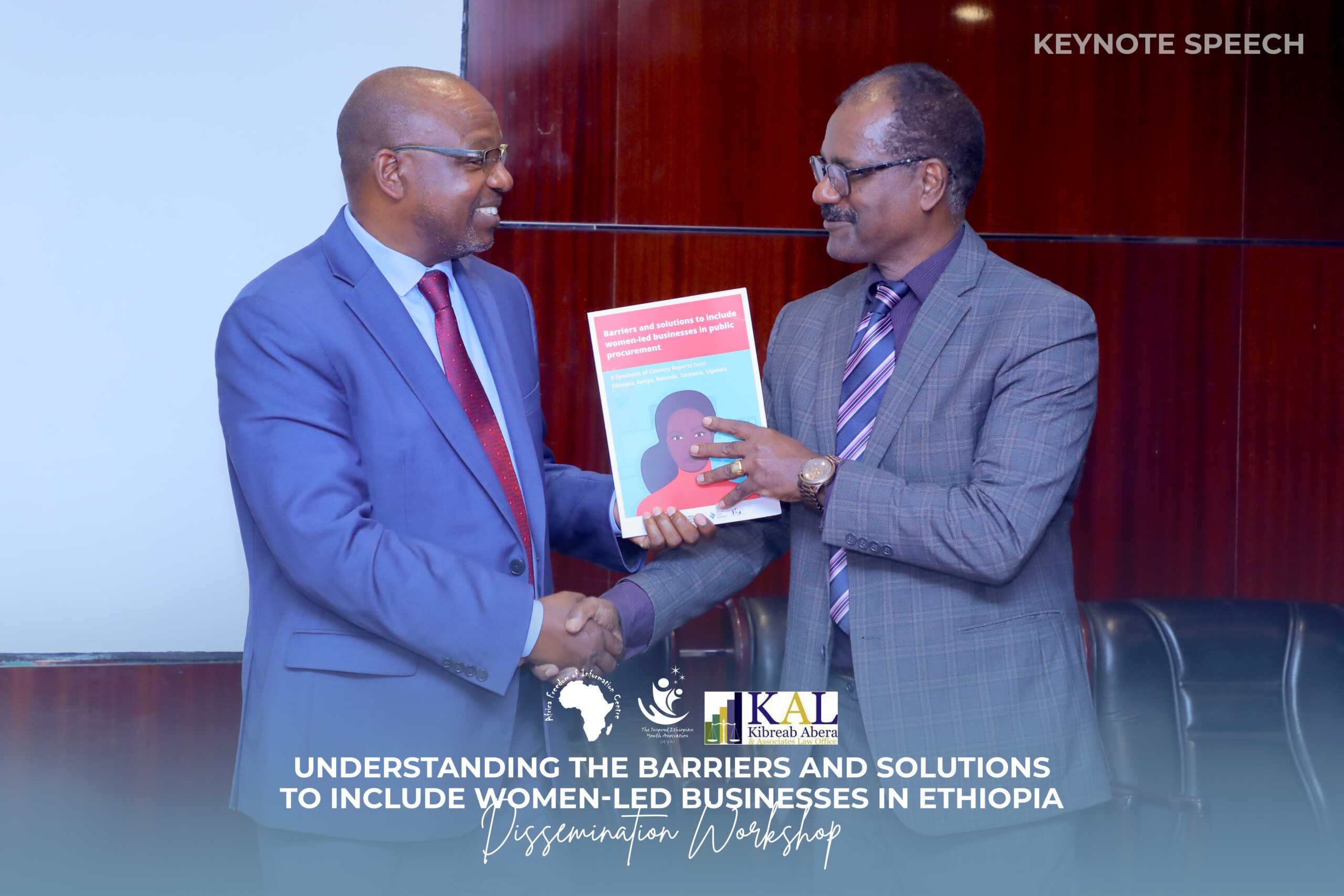
Fostering Gender Responsive Public Procurement: Understanding the Barriers and Solutions to Include Women-Led Businesses in East Africa.
The government procurement sector is a massive market worldwide, with many governments spending around 15% of their GDP on goods, works, and services every year. This presents a significant opportunity to address labour market segregation and gender employment gaps, which hinder women’s financial and social development. To achieve this potential, policies and practices that actively promote the inclusion of women-led businesses and conscious efforts to integrate and include women in the labour market are necessary. However, women-led businesses are vastly underrepresented in this market due to gender bias and rigid power dynamics that perpetuate discrimination and oppression.
Project Summary
To address this issue, AFIC, in collaboration with TISA and OCP, conducted research in five Eastern African countries (Ethiopia, Kenya, Rwanda, Tanzania and Uganda). The research aimed to understand the rates of participation and challenges facing women-led businesses and sole proprietorships, identify measures being implemented to improve fairness and inclusion of women in public procurement, assess the impact of government measures to improve fairness and inclusion and recommend actionable changes based on international best practices.
Project objectives
- To understand the rates of participation and challenges facing women-led businesses and sole proprietorships;
- To identify which measures are already being implemented or tested to improve fairness and inclusion of women into public procurement in the selected countries;
- To assess the impact of the measures put in place by specific governments to improve fairness and inclusion;
- To recommend actionable changes to improve the current situation, based on the findings of the research and international best practice.
Advocacy objectives
(i) to advocate for the adoption and operationalisation of policies, procedures and guidelines that address gender injustice and inequality in public
procurement in EA.
(ii) promote data collection systems that promote collection, storage and reporting of gender disaggregated data by the government with specific focus on procurement data.
iii) strengthen the capacity of WLBs to participate in public procurement.
( iv) promote access and use of knowledge and evidence from this policy research to address barriers faced by WLBs in public procurement and last but not least.
(v) to proactively engage with policymakers, practitioners and the private sector with GrOW research.
Reports
Synthesis report: https://www.africafoicentre.org/wpdmpro/final-synthesis-report-on-the-barriers-and-solutions-to-womens-participation-in-public-procurement-in-eastern-africa/
Rwanda :https://www.africafoicentre.org/wpdmpro/towards-gender-balance-understanding-the-barriers-and-solutions-to-include-women-led-businesses-in-public-procurement-rwanda-final-country-report/
Tanzania:https://www.africafoicentre.org/wpdmpro/towards-gender-balance-understanding-the-barriers-and-solutions-to-include-women-led-businesses-in-public-procurement-tanzania-final-report/
Kenya: https://www.africafoicentre.org/wpdmpro/towards-gender-balance-understanding-the-barriers-and-solutions-to-include-women-led-businesses-in-public-procurement-kenya-final-country-report/
Get In Touch With Us Today
- Civil Society Letter to States Parties to United Nations Convention against Corruption
- Promoting Freedom of Expression and Access to Information in East Africa: AFIC Launches New UNESCO–IPDC Project
- Reclaiming Our Data Futures: AFIC Leads Community Dialogue on ACHPR Resolution 620 at DataFest Africa 2025
- Uganda Marks IDUAI 2025 with a Call for Digital Accessibility to Public Information
- Sénégal : La promulgation de la loi sur l’accèsà l’information, une étape importante pour la transparence
