


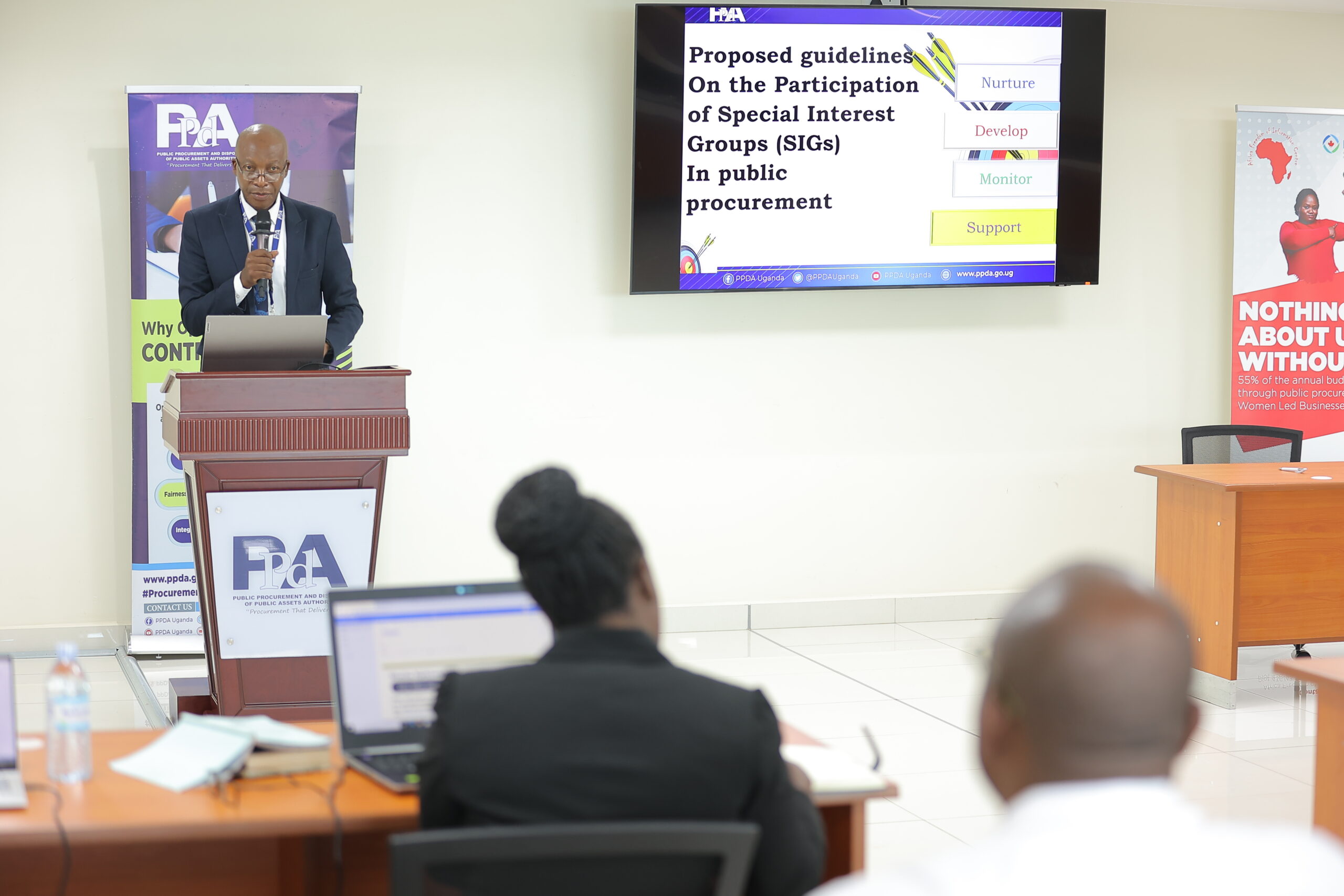
Africa Freedom of Information Centre (AFIC) in partnership with the Ministry of Gender, Labour and Social Development (MGLSD) conducted a multi stakeholders’ engagement to discuss the findings on the AFIC report and the draft procurement guidelines by the Public Procurement and Disposal of Public Assets Authority (PPDA)
The meeting was held on the 31st August, 2023 at Hotel and attracted at least 35 stake holders including the various departments at the Ministry like gender and women /affairs which was in the lead. Other departments included the youth and Persons with disabilities. Other government institution s included the Ministry of Finance, Planning and Economic development, Uganda Bureau of Statistics and Public Procurement and Disposal of Public Assets, Development partners including UNDP and UN Women were among the participants, as well as the Finance institutions like Finance Trust Bank, CSOs were equally represented in the meeting.
The overall objective of the meeting was to facilitate stakeholder interaction on challenges affecting WLBs’ participation in public procurement and jointly identify strategies for addressing them in the draft guidelines for the reservation scheme for special interest groups.
The meeting came up with the position that the draft guidelines be implemented in the state they are in and address the gaps there in along the way. They also resolved to support collaborative efforts of stakeholders in building the capacities of the women led businesses in public procurement.
Development partners urged the participants, especially the organizers of the meeting, to embrace the new challenges including digitalization of the procurement processes so as to equip the women thoroughly and be in position to compete favorably.
Presentations
AFIC Study findings
Charity Komujjurizi, the Monitoring and Evaluation Coordinator, made a presentation on the study by AFIC, whose title was “Barriers and Solutions to Women-led Businesses’ Participation in Public Procurement in Uganda“. She stated that the study used mixed, qualitative and quantitative methods to collect data from Kampala, Gulu, and Mbale, including online data collected from various districts.
The key findings of the study include but are not limited to the following;
- There is no clear definition of women-led businesses.
- It was also found that 60% of the government’s expenditure is spent on public procurement yet only 1% of the women participate.
- 38% of businesses were owned by women and only 44% of those were duly registered.
- 45% of the registered women-led businesses were concentrated in the supply sector.
- 70% of the WLBs were concentrated in Kampala and Wakiso Districts with 44.7% and 25.2% respectively.
Charity ended by stating that the research findings underscored the need to address the challenges highlighted in the research report since the women’s failure to partake in public procurement limits their earnings. There is a need for the relevant stakeholders to play their part such that the above-mentioned challenges are combatted.
Draft Procurement Guidelines by PPDA
Ronald Tumuhairwe, the Manager of Local Content at PPDA, made a presentation, discussing the draft guidelines for the reservation scheme outlined in the PPDA Act. He stated that the Act was established in 2003 and thereafter amended in 2021 to actualize the preferential and reservation schemes provided for under Section 50 as a way of affirmative action of special interest groups’ participation in public procurement. This was made to promote and encourage the participation of special interest groups such as women, youth, and persons with disabilities, as well as to promote local content. He further stated that the guidelines to operationalize Sections 59A and 59B are in their final stages and that the guidelines aim to define who qualifies for the reservation scheme benefits, including enterprises owned and run by at least 51% women and youth-owned enterprises with a majority of youth leadership. Reservation means that a portion has been set aside for a particular group.
He stated further, that according to the draft guidelines, any procurement of less than 10 million Uganda Shillings must go to special interest groups. These groups will be given a margin of preference, and they will not need to go to the bank to get bid securities. The bid security is a commitment to stick to the bidding conditions and terms. There will be no bidding fees for special interest groups, and annual turnover should not exceed half of the special interest group entities’ capacity.
He stated that PPDA will develop a database for special interest group enterprises service providers, and also work with the Ministry of Finance and that of Gender to have the guidelines operational. A team would be set up to monitor the implementation of the scheme.
Bank Representative
Ritah Bazabyabwe from Finance Trust Bank:
Ritah stated that Finance Trust Bank is a Women’s Bank that primarily focuses on women. She said that it was formally the Women’s Trust Bank.
In a bid to support women, Ritah stated that the bank has low interest rates, provides financial literacy, medical insurance, and networking for women in business. Other opportunities identified that are offered include, bid securities guarantee, performance guarantee, advance payment guarantee, invoice discounting, letters of credit and warehouse receipt financing. They target small and medium enterprises and are aware that most women’s businesses are informal. She stated that there is generally a fear among women that once businesses are formalized, URA will come for them. It was thus suggested that to erase that fear, there should be deliberate plans to publish success stories and musical works so that women can have their mindset changed in that direction.
Plenary Discussion Session:
The plenary discussion was chaired by Assistant Commissioner Margret Kyomukama
Comments, Question and Answers
Harriet;
- submitted that there appears to be a lack of confidence among women when it comes to engaging in business. She wondered how the same could be overcome.
- Additionally, she stated that there is a gap in access to information about public procurement among the general populace. “How can we bridge this gap?” she wondered.
- Many women and youth have attempted to bid for contracts, but have been unsuccessful. “Is there a way to engage those who have failed? Is there real-time data available from the relevant entities?” She enquired.
Hon. Gorreth Namuga;
- Member of Parliament and member of UWOPA, noted that there is a significant amount of mistrust in the procurement process and that corruption has resulted in losses of over a billion shillings. In response to some companies being unable to perform, the government has decided to award some contracts to the UPDF Brigade, she added. “How many women have accessed funds through UDB, the Micro Finance Support Centre, and the Parish Development Model?” she asked.
- The Honourable Member of Parliament stated that the August House is currently searching for a way to make funds more readily accessible and affordable.
- Additionally, she said, there is a need to create a threshold for various contracts and to simplify and make the bidding process more accommodative.
- Timely delivery of services has also been an issue. She revealed that UWOPA is working on a plan to train women and develop a tool to help them with budgeting and monitoring.
Julius from the Ministry of GLSD;
- Noted that as a way of monitoring the women empowerment government schemes, a visit was made to about 10 districts and it was found that there is a lack of data on the beneficiaries of the PDM scheme in the 10 visited districts. He stated that while on the visit, he advised that there is a need to meet with the CAOs to demand the list of beneficiaries and expand on the characteristics of those who are missing out.
- Additionally, in reaction to the guidelines, he called for an expeditious gazzeting of the guidelines and address the gaps as they are identified lest they are never implemented. revision or review would be attended to later while in operation.
- Julius also noted that the entities registered at the local level should also be accommodated, not just those registered by URSB. He further stated that the bid documents should be expanded to make the process language-friendly, and language boards in all local governments should be utilized.
Joan Babirye of UN Women;
- Emphasized the need to embrace the digital era and empower women to take their businesses to the next level. She stated that the interest groups should be educated on the e-GP system, and revealed that the UN Women will provide training on how the e-GP system is used.
Yonna Wasswa;
- The chairperson of People with Disabilities, noted that the PPDA process is extremely exclusive of PWDs. He wondered if there was a provision for an audio-video format in the e-GP system. He stated that PWDs should be engaged to develop a comprehensive format that is inclusive of all types of disabilities. PWDs often miss deadlines due to the complexity of the process. He referred to Kenya as the state in East Africa that currently presents a better procurement process and that Uganda should pick a leaf from the same.
Responses
Charity’s Response: In response to some queries about the monitoring mechanism of some government entities, Charity noted that AFIC has partnered with some government entities to monitor government practices, but was quick to add that some departments are resistant to the practice and assert that they have their own mechanisms.
Ronald the PPDA: Ronald responded that PPDA has partnered with the CSOs and developed a monitoring tool to capture and provide feedback on the activities in the populace. He further stated that as an entity they disseminate information through the media and most time using the government airtime. He revealed that in the first draft, PPDA looked at reserving categories based on the skills that youth and women have been empowered with. However, after consultations, it was found that some operators have been given space for contracts like license collections, therefore, it would be difficult to ring-fence such services to the interest groups. He associated himself with the thought that the guidelines need to be gazetted, and promised to follow up on the same with the relevant offices.
On the point of translation of bid documents, he also noted that it was something they as PPDA are working on.
About the complexity of bid documents, he said that it is sometimes acceptable to use documents that suit the circumstances other than the official ones. The documents should be acceptable in practice. It is indeed fortified by Section 59B(3)(a) which provides for this position of using alternative procedures and documents by a procuring and disposing entity that intends to use the reservation scheme after seeking permission from the Authority.
Way Forward
A number of action points were suggested which include the following;
- Work on collaborative partnerships between the Ministry and CSOs on women in public procurement
- Build the capacity of women in digital procurement processes with support from UN Women
- Conduct access to information sessions to women entrepreneurs on the guidelines and existing opportunities in financial institution and government
- Partner with Financial Institutions to support women access to credit.
- The PPDA and Ministry of Finance to expedite the gazette of the guidelines to start on implementation immediately
- Engage CSOs to understand the provisions of the guidelines to help them in the promotion and awareness of the guidelines, and
- Share the presentations and draft guidelines to familiarize ourselves with them.
- Have similar and regular engagements on public procurement
